
Posted 27 May, 2026 by Lewis Chawko
I sometimes ask founders a simple question: "If you hit your number this quarter, would you know exactly why?"
Too often the answer is a nervous laugh and something like "Well, outbound was decent, marketing did a webinar, a few partners came through and we had a big deal come in at the end of the month.”
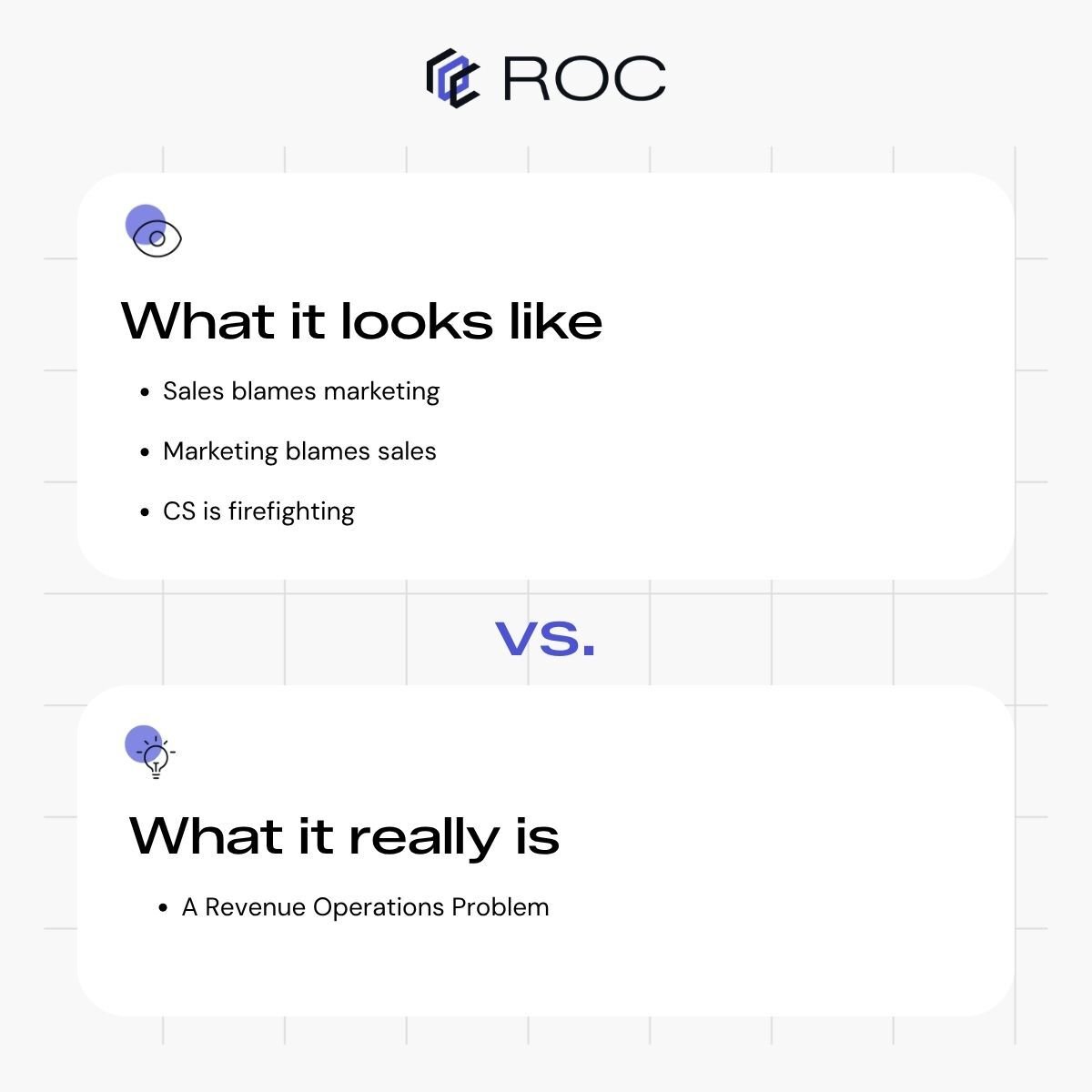
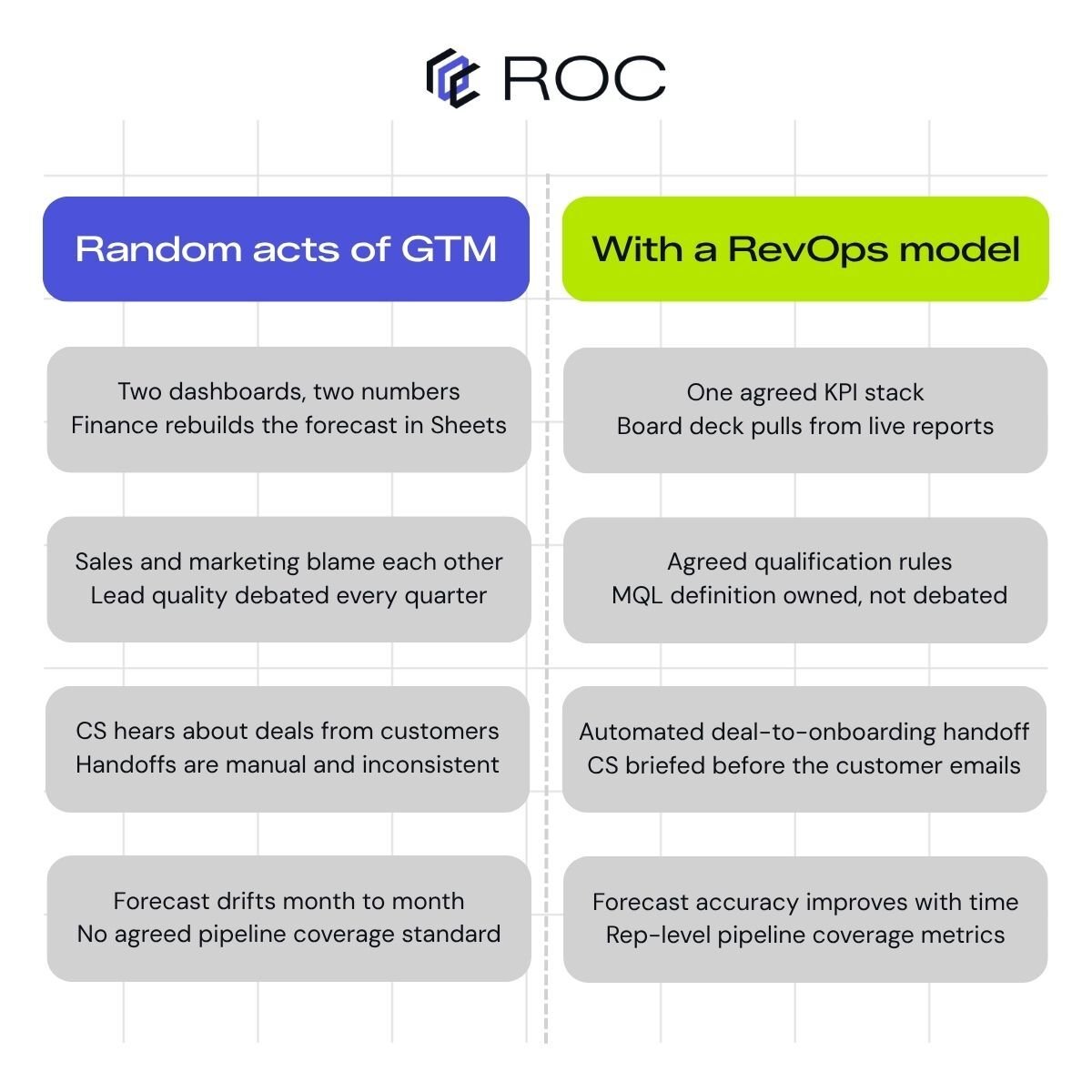
In the early days, that is understandable. Random acts of go-to-market can get you from zero to your first million in ARR, especially with founder-led sales. A Founding AE here, an investor-introduced deal there, a surprisingly effective LinkedIn campaign. But as you approach 2m, 5m, 10m ARR this doesn’t generate the same results it once did. Marketing swear they are sending brilliant leads (usually, if the quality bar is high, they are). Sales swear the leads are not. Customer success drown in onboarding that arrive half-baked and they end up asking the same discovery questions during onboarding. Forecasts drifts month by month.
When sales and marketing are blaming each other, the real issue is usually neither of them.
Several operators have written about this. Highspot frame it as the need for a RevOps framework that aligns people, process, data and technology around a single revenue story, rather than three competing ones: RevOps frameworks for growth. Rework describe the same dynamic in their SaaS RevOps framework, talking about silos and misaligned KPIs as the quiet killers of growth: SaaS RevOps framework.
From our perspective, the signal that you need a framework is not abstract, however, it is practical. Your leadership meetings fill up with arguments about which dashboard is "more accurate” rather than focussing on problems to solve. Your CRO and CMO cannot agree on basic funnel conversion. Your CS team hears about new deals only when a customer emails support in confusion. Pipeline coverage is something someone reworks in Google Sheets or Excel the night before an investor update.
At that point, you have two choices. You can keep buying point solutions and hoping one of them provides answers. Or you can admit that you are missing a coherent revenue operating model, and do the work. (Spoiler alert: buying tools doesn't make problems go away).
RevOps, is not a department. It is an operating model. It is a shared way of defining stages, metrics, handoffs and responsibilities. A shared view of which levers are real and which are theatre. A shared discipline around how data is captured, governed and used
Once you make that mental shift, you stop asking "Should we hire a RevOps person?" and start asking "How do we want this engine to run, and who is going to own it?"
The core pillars of a SaaS RevOps framework:
The internet is full of clever diagrams. Bowties, flywheels, RACI matrices. Underneath the branding, the same few ideas keep showing up. The useful RevOps frameworks are boringly consistent.
Rework have done a good job breaking it down into four layers:
- Strategy and Planning
- Operations and Execution
- Technology and Tools
- Data and Analytics
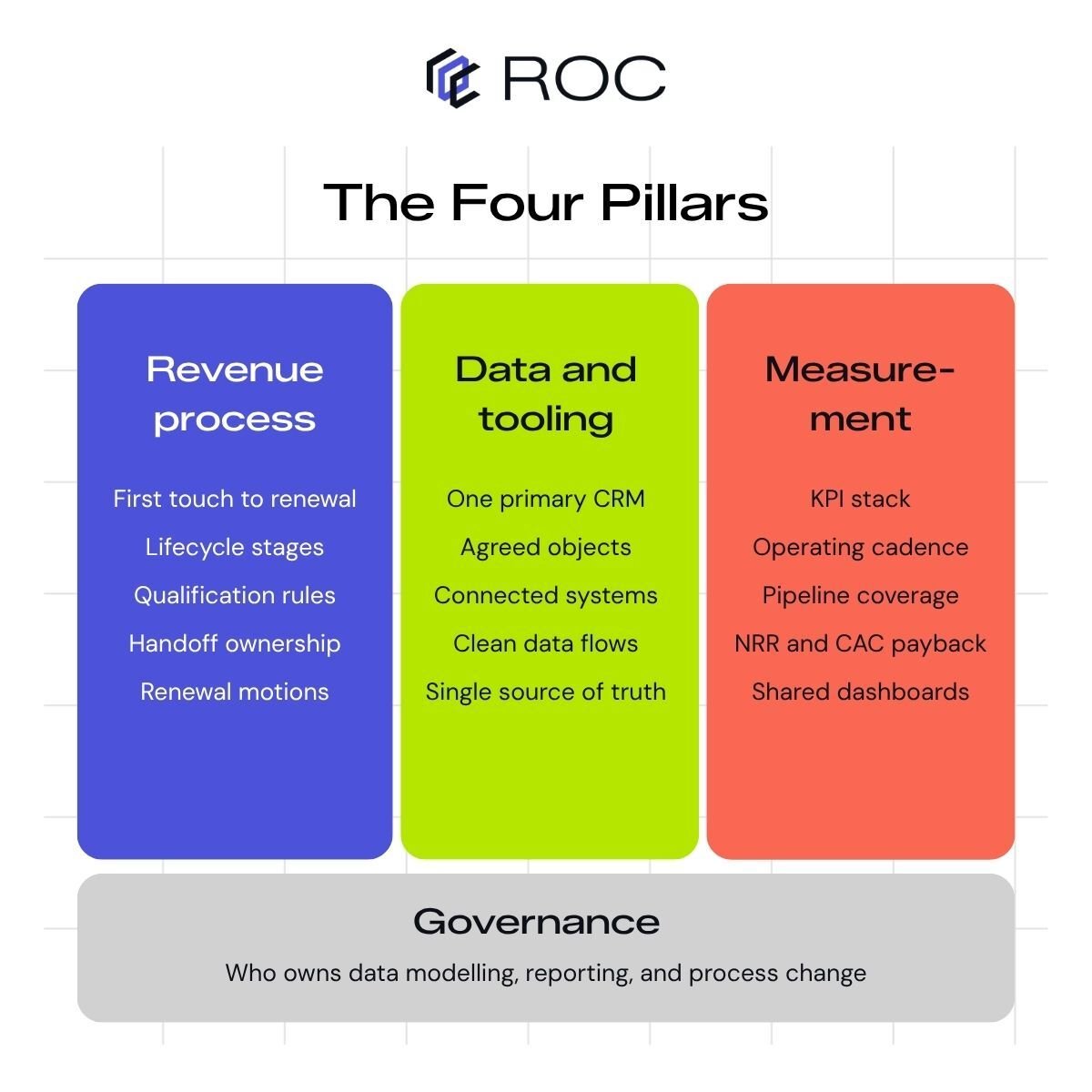
If you are running a B2B SaaS company, I would compress all of that into four practical pillars.
-
Pillar 1 - Revenue Process -
-
Not just a sales process but an end-to-end view from first touch to renewal and expansion, sometimes called lead-to-cash. This is where you define your lifecycle stages, your lead qualification rules, your sales stages, scoring, your onboarding journey and your renewal and cross-sell motions. It is where you decide, very explicitly, who owns what at each step and what "good" looks like.
-
-
Pillar 2 - Data and Tooling -
-
That means one primary CRM, one agreed set of objects and properties, a limited number of connected systems, and clarity on how data flows between them. If your CRM, marketing automation and CS platform all tell different stories, your framework is theory only.
-
-
Pillar 3 - Measurement and Rhythm -
-
That is your KPI stack and your operating cadence. What do you measure weekly, monthly, quarterly? Which handful of metrics genuinely predict revenue health for your model? Net revenue retention, pipeline coverage by segment, sales cycle length, conversion by stage, CAC and payback, usage based health scores. This should be agreed by the GTM leadership team
-
Governance sits underneath all three pillars. Who is allowed to create new fields? Who approves changes to process? Who owns report definitions? Without that, even the prettiest framework will crumble under the weight of quick changes and hacking the tooling together.
The truth is that your framework does not need to be original. It needs to be explicit, shared, and boringly enforced. The value lies not in picking the perfect acronym, but in getting your Head of Sales, Head of Marketing and Head of CS to agree that this is how the machine will run for the next 12 months.
Embedding RevOps frameworks into HubSpot and your GTM rhythm:
Frameworks only matter if you can feel them in your tools and your team.
For most startups and scaleups I work with, HubSpot is the natural home for operationalising RevOps. It holds your contacts, companies, deals, tickets and in most cases your marketing and CS activity. If your framework lives in a slide deck but not in your HubSpot configuration, you have a gap.
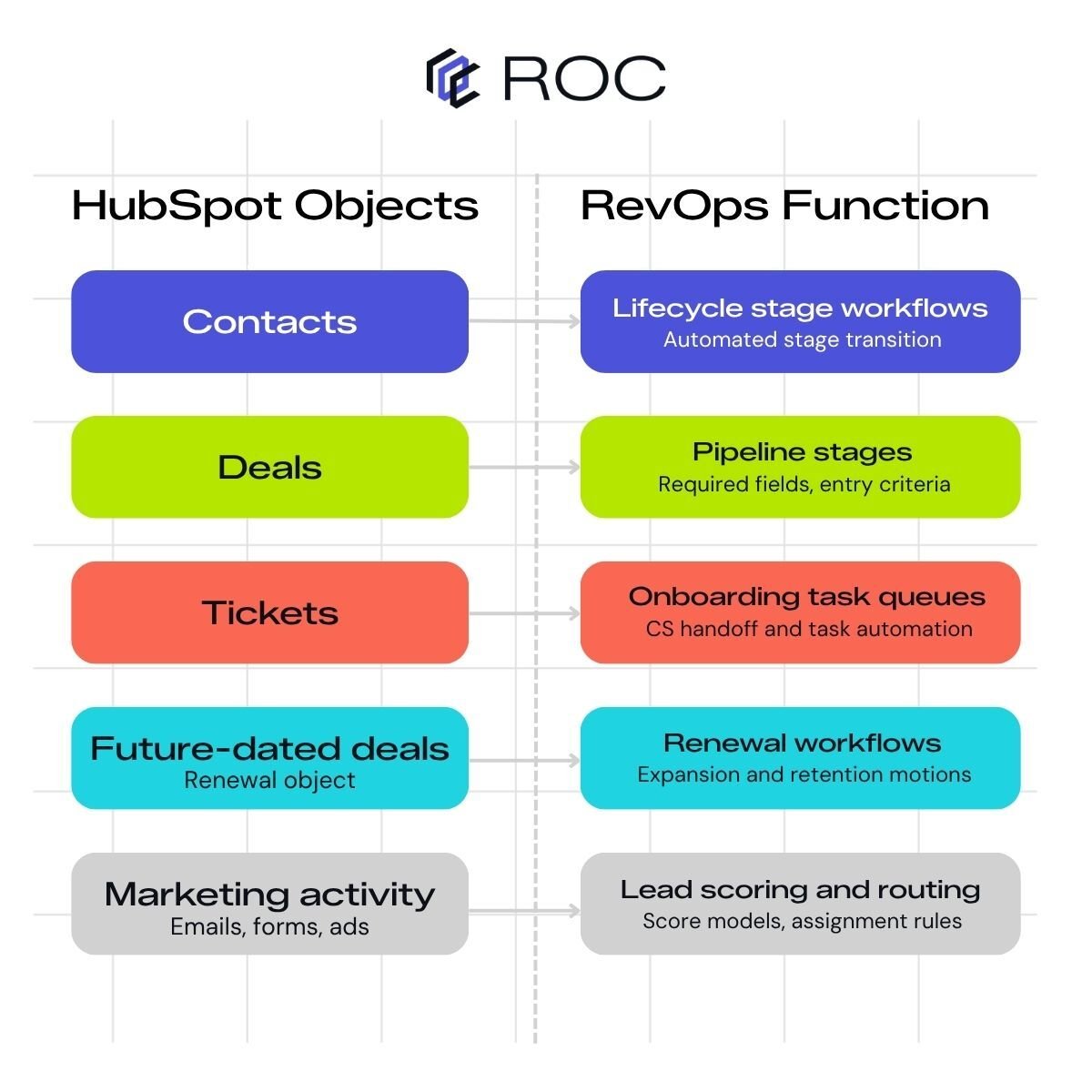
Practically, this means mapping each piece of your framework to something in HubSpot. Lifecycle definitions become lifecycle properties and life-cycle based workflows. Lead qualification rules become score models and routing logic. Sales stages become pipeline stages with required fields and entry criteria. Onboarding steps become tickets and task queues. Renewal motions become future dated deals and renewal workflows.
On the measurement side, your RevOps metrics become shared dashboards. A small set of views you use live in meetings, not dashboards teams ignore. A weekly go to market standup that looks at top of funnel, mid funnel and post-sale health. A monthly leadership review that inspects pipeline coverage, forecast accuracy, net revenue retention and segment performance. A quarterly board pack that pulls directly from the same reports, not last minute exports.
The final ingredient is cultural. You need a RevOps owner who treats the framework like a product, not a project. Someone who keeps a changelog, runs regular audits, rejects random property requests, and gently but firmly pushes the organisation back to the agreed model when shortcuts are suggested. For a time, this might be the sales rep with natural RevOps instincts who hasn't named it yet. That's a reasonable starting point.
When you get this right, something interesting happens. Your SDRs might not talk about "the RevOps framework," but they feel it in the clarity of their workstreams and the consistency of follow-up. Your sales managers feel it in cleaner pipeline reviews, better coaching sessions and decision-making. Your CSMs feel it in smoother handoffs, quicker customer onboarding and better renewal conversations. Your finance team see it when the numbers in HubSpot, Stripe and the board deck finally match. That is the goal.
That is the test. A RevOps framework that works is one your teams never need to name, because it quietly makes their lives easier and your revenue more predictable.
If this sounds familiar, you’re not alone.
Most B2B SaaS companies hit a point where founder-led GTM and improvised processes stop scaling. The good news is that you don’t need a full in-house RevOps team to fix it.
We work with growing SaaS companies to design and implement practical RevOps frameworks, aligning sales, marketing and customer success around one shared revenue engine, usually built directly inside HubSpot.
If you’re approaching £1–10M ARR, scaling your sales team, or considering HubSpot as your CRM, it might be the right time to put the foundations in place.
Book a 30-minute RevOps diagnostic call and we’ll walk through:
- Where your revenue process may be breaking
- What your RevOps framework could look like
- How to operationalise it inside HubSpot
FAQs