
RevOps
Posted 18 Aug, 2026 by Lewis Chawko
When your CRM is not giving useful answers, the instinct is to add more fields. Almost always the wrong move.
The fix is a CRM field audit, cutting the properties that drive nothing and adding the few that predict deals.
A CRM that does not tell you what you need to know feels like it is missing data. So teams add fields. More properties, more dropdowns, more required boxes. A year later the CRM is heavier, reps fill even less of it, and the answers are no clearer.
The problem is rarely too few fields. It is too many of the wrong ones and a handful of the right ones missing. Bloat is not the same as coverage.
Why more fields make it worse
Every field is a small tax on the person entering data. Add enough low-value ones and three things happen:
- Reps disengage. Faced with twenty fields on a new contact, they fill the two that are required and skip the rest.
- The important fields get buried. The one property that drives routing sits next to fifteen that drive nothing, and gets the same treatment.
- Reporting gets less reliable, not more. A half-filled field is worse than no field, because it looks like data and lies. Reliable reporting starts with one trusted view of your data, not more places to store it. Click here to read why the single source of truth problem is really a trust problem.
More fields is how a CRM becomes something reps resent and leadership cannot trust. The instinct to add is the instinct that broke it.
What "the right fields" actually means
A field earns its place only if it changes a decision or an action. Ask of any property: what does this change? If the answer is a routing rule, a score, a report leadership uses, or a rep's next step, keep it. If the answer is "it might be useful one day", it is noise. Useful-one-day fields are where CRM bloat comes from.
The right fields are the few that drive what you do next. Everything else is decoration that costs you adoption.
The fields most teams are missing
The valuable data is usually the stuff sales hears in conversations and never logs, because there was no clean place for it or no reason to. A sales rep hears the deal is blocked on budget sign-off from a new CFO, and logs it nowhere, because the only place for it is a free-text note nobody reports on.
The buying signals that actually predict a deal:
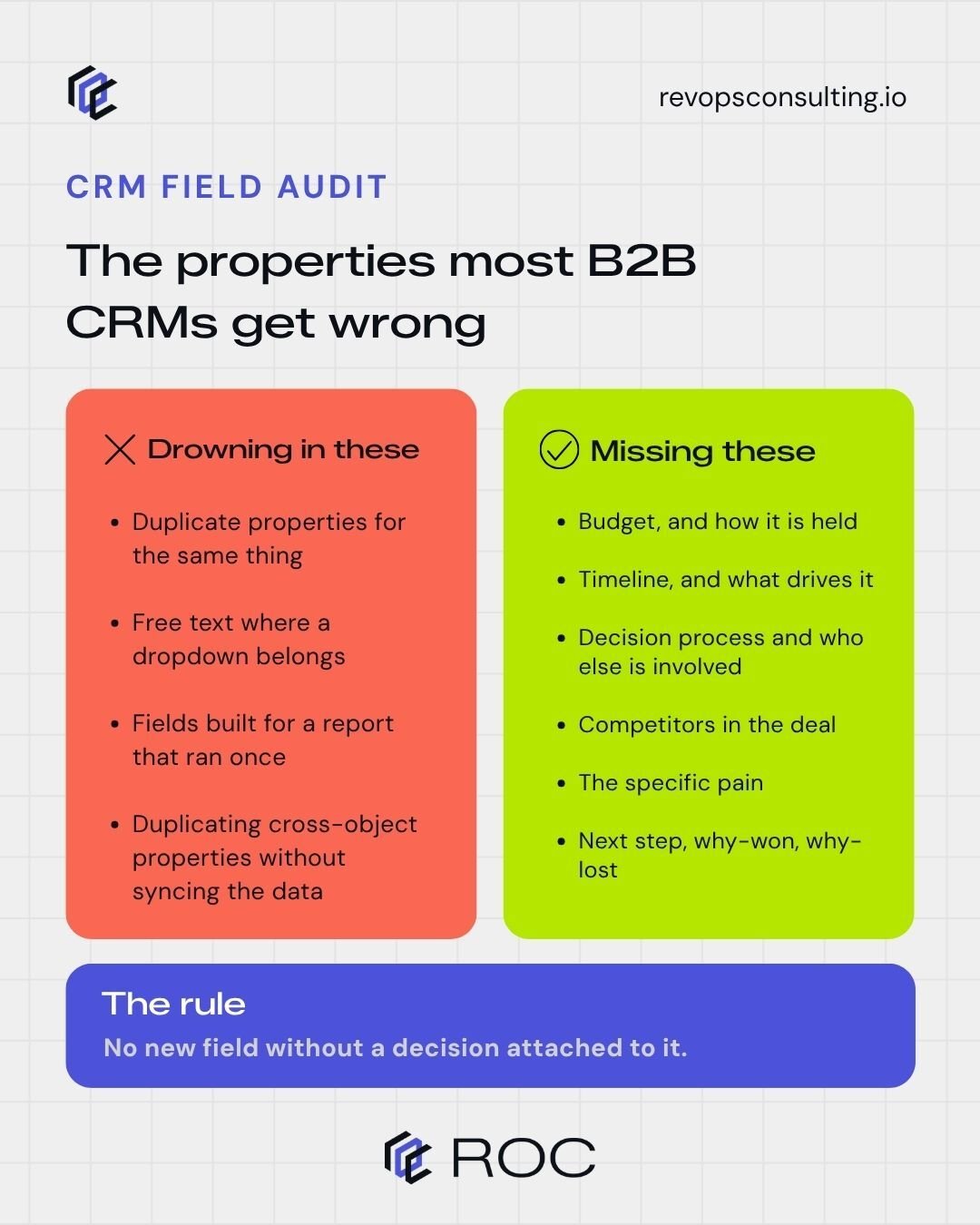
- Budget and how it is held
- Timeline and what is driving it
- The decision process and who else is involved
- Which competitors are in the picture
- The specific pain behind the search
Plus the operational fields that earn their keep: a Next Step property on every open deal, a proper Deal Source (Original and Latest, kept distinct), and structured Closed Won Reason and Closed Lost Reason as dropdown selects rather than free text.
The fields most teams have too many of
The dead weight is just as consistent: duplicate properties capturing the same thing slightly differently, free-text boxes where a dropdown belongs, fields created for a report that ran once, and "nice to know" attributes nobody has ever filtered on. Each one dilutes the data that matters.
How to run a CRM field audit
A field audit is one of the highest-return, lowest-cost things you can do to a CRM:
- List every property, then check the 'Used in' data under Settings > Properties to see what each one feeds. Export the full property list so you are auditing against reality, not memory.
- For each, answer "what decision or action does this change?" Cut the ones with no answer.
- Add the small set of genuinely useful fields you are missing, mostly the buying signals above.
- Make the ones that matter required at the right stage using conditional stage properties, so a rep only fills them to move a deal forward, not on every record from the start.
- Use dropdown select properties and validation rules so the data is clean enough to filter, segment and build into a report. Free text kills reporting.
You will usually end with fewer fields, higher completion, and a CRM that finally answers the questions you were adding fields to answer.
The test that keeps it clean
Hold the line going forward with one rule: no new field without a decision attached to it. If someone wants to add a property, they name the report, routing rule, score or next step it drives. No decision, no field. That single discipline stops the bloat coming back.
The point
Your CRM does not need more fields. It needs the right ones, filled consistently, and the rest cleared out. The goal is not to capture everything. It is to capture the few things you will act on, well enough to trust. A lean CRM with the right fields beats a bloated one with all of them, every time.
The pattern here is the same one behind hitting targets without over-hiring: fix the engine you have before you add to it. Click here to read how to hit targets without adding full-time RevOps.
If your CRM has grown into a field graveyard and still does not answer the questions that matter, a RevOps Audit strips it back to what drives decisions and gives you the roadmap to fix it. [Book a RevOps Audit]
Not sure whether now is the moment to bring in help. Click here to read when to build RevOps and why fractional fits most scaleups.
Lewis Chawko is the founder of ROC, a fractional RevOps consultancy helping B2B tech startups and scaleups build revenue systems that scale on HubSpot.
FAQs