
Posted 30 Jul, 2026 by Lewis Chawko

Your pipeline looks busy. Your revenue does not follow. Here is how to find where it is leaking, instead of guessing.
Revenue leaks are the stage transitions where qualified demand stalls or disappears, most often between discovery and qualified opportunity, MQL and sales accepted, and verbal yes and closed won.
Ask this in your next forecast review and watch a roomful of smart people avoid eye contact: "Where, exactly, is revenue leaking in our funnel?"
The answers usually drift. "Mid-funnel is a bit soft." "Leads feel lighter than last quarter." "Enterprise cycles are longer at the moment." Meanwhile the slide says traffic is healthy, campaigns are producing MQLs, calendars are full. Bookings refuse to follow.
This is the uncomfortable bit for a lot of founders. The problem is not an empty funnel. It is a dishonest one.
Where your SaaS funnel leaks revenue
The diagram on the wall shows a tidy march from awareness to revenue. Real buyers meander. They bounce between channels, go dark, re-emerge six months later, drag procurement and security in at awkward moments, and talk to three of your competitors on the side. Treat the funnel as a vanity picture and you will never see where the money evaporates.
A better start is to write down, in plain language, the real steps your buyers take. Not the ones you wish they took. For most B2B SaaS, something like:
- Anonymous visitor who fits your ICP
- First real signal of interest: a webinar, a partner intro, an SDR conversation
- Marketing qualified against agreed criteria
- Sales accepted, with a named human who has taken responsibility
- Proper discovery, not a rushed demo
- Serious evaluation, including commercial discussion
- Paperwork, security and procurement
- Verbal yes
- Onboarding and first value
Once the journey is on paper, the questions get sharper. Where do conversations disappear? Where do deals sit in a stage for weeks with no activity? Where do you get ghosted, and why?
You might find deals dying between demo and proposal. Or inbound in one segment sitting untouched for days because a routing rule quietly broke. Or security reviews doubling your cycle in financial services with no playbook to handle them. Until you point at specifics like these, talk of "RevOps" is theatre.
Data gets you part of the way. A dashboard shows where conversion collapses. It will not tell you AEs are running discovery as a slideshow, or that your trial leaves buyers more confused than excited. The best RevOps people are part analyst, part journalist. They pair the funnel numbers with call listening, rep interviews and an almost irritating curiosity about how buyers experience the journey.
A quick diagnostic: pick one stage transition and ask three people from different teams to describe it without looking at a slide. The answers tell you whether you have a data problem, a process problem or a shared-reality problem.
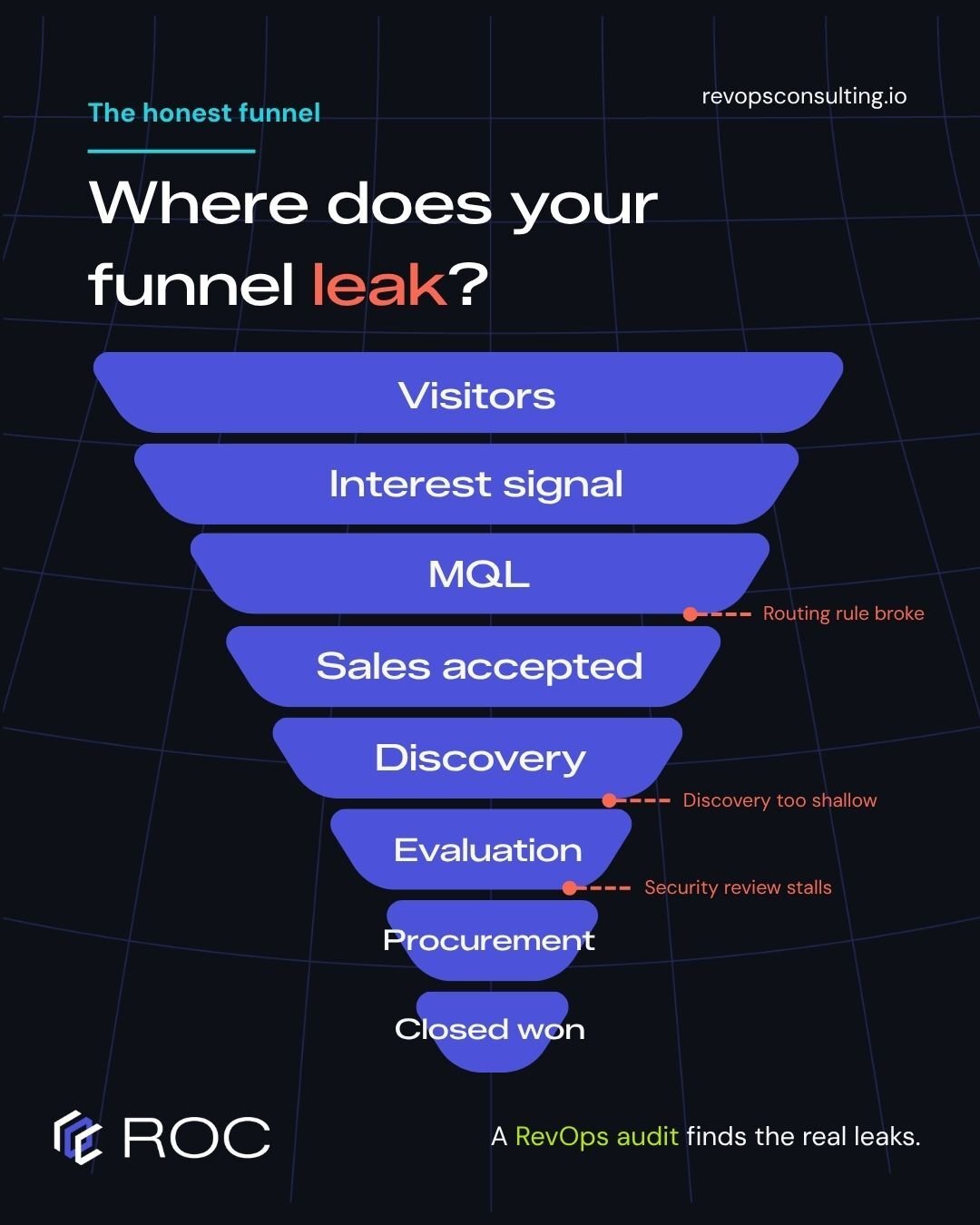
Turn a funnel leak into a fix
Once you spot a leak, the temptation is to grab the nearest tactic. More leads. New sequences. A pricing tweak. Buying another tool feels like progress here. Usually it is motion. Read why adding tools is not scaling your GTM. The pressure to do something is real, especially after a quarter has gone sideways. The risk is you treat the symptom and miss the cause.
Say the data shows a sharp drop between first discovery and qualified opportunity. Easy to blame lead quality. Far more often the culprit is some mix of fuzzy ICP, weak discovery discipline and a value proposition stretched across too many segments. The fix there is not more top-of-funnel spend. It is a hard look at qualification and messaging.
The loop is simple: locate the leak, understand the why, design a specific fix, instrument it, review. In practice that might be:
- Tightening ICP definitions and making sure marketing targets against them
- Rewriting discovery questions to surface urgency, budget and internal politics earlier
- Giving buyers a simple mutual action plan so they leave the first call knowing what comes next
- Coaching reps to tell curiosity from intent, and to disqualify politely when the fit is wrong
If the leak is earlier, this is pipeline leakage between MQL and sales-accepted, and the work tilts to marketing ops and RevOps. Weak MQL to SQL conversion here is rarely a volume problem. Check your lead scoring is not over-rewarding shallow engagement and under-weighting real intent. If your scoring is the culprit, read our full guide to setting up HubSpot lead scoring your sales team trusts. Make sure HubSpot routing is not dropping key segments into a generic queue. Agree what "sales ready" means and reflect it in both form fields and SLAs.
Further down, leaks hide in the grown-up bits. Security reviews. Procurement. Legal. Internal approvals. Strong deals stall here and haunt three or four quarters of your forecast. Fixing them rarely needs a platform. It needs:
- Working with CS to understand what worries buyers about implementation and risk
- Simplifying standard contracts with legal, and agreeing fallback positions that do not need a fortnight of internal wrangling
- Equipping sales with pre-emptive content: security summaries, implementation plans, customer stories built around risk, not features
The thread through all of it is cross-functional ownership. If RevOps sits alone in a corner building ever-richer reports while everyone else carries on, nothing changes. Diagnosing the bottleneck is half the job. The other half is dragging the finding into a room where product, marketing, sales and CS argue about it constructively.
The leaders who do this well insist on one simple artefact a quarter:
- Here is where revenue is leaking
- Here is our best read on why
- Here is what we will try
- Here is how we will know if it worked
It sounds almost insultingly basic. It is also rare.
Make funnel diagnostics part of your cadence
The first proper funnel diagnostic will surface more problems than you have capacity to fix. That is healthy. It means you have stopped pretending and started looking.
Then it becomes a question of discipline. Is a diagnostic a one-off, or part of how you run revenue? For more on this, read our breakdown of a RevOps operating model that works for B2B SaaS.
Teams who treat it as a one-off ping-pong between initiatives. One quarter is all top-of-funnel, the next is close rates. Tools arrive, old ones linger, and nobody quite remembers which leak they were fixing.
Teams who build it in behave more like engineers. They accept a growing SaaS business is a living system. Bottlenecks move as segments mature, the product evolves and hiring comes in waves. The aim is not a mythical perfect funnel. It is to notice early where reality has drifted from your mental model, and correct before it lands hard in the P&L.
That means making diagnostics boringly routine:
- A quarterly funnel review on the same conversion metrics and journey stages, where RevOps presents a short narrative, not a 60-slide deck
- A monthly working session between sales and marketing on one stage transition, with experiments agreed and tracked
- A standing exec-meeting question: what did we learn about how buyers move through the system this quarter?
Start small. One stage, one leak, one fix, one review.
The other ingredient is humility. You will run experiments that flop. You will fix one leak and expose another. You will find that cherished stories about why deals die are wrong. The more you move the culture from blame to curiosity, the more progress you make. Instead of "who dropped the ball", ask "what about our system made it easy to drop". Instead of celebrating heroic end-of-quarter sprints, celebrate the quiet gains in conversion and cycle time that make the heroics unnecessary.
Over time something shifts. GTM stops feeling like sprinting through treacle and starts feeling like working inside a machine that, while imperfect, is at least honest. Marketing sees which campaigns move revenue, not only clicks. Sales trusts the CRM enough to drop the shadow pipeline. CS reads expansion and renewal from patterns rather than hunches.
And when you are asked why you missed a quarter, you have something better than "it was harder out there". You point at specific bottlenecks, explain what you are doing about them, and show the system is learning.
That is what RevOps is for. Not pretty charts or a bigger stack. A calmer, more honest way to run revenue in a market with little patience left for wishful thinking.
If your pipeline looks healthy but revenue keeps arriving lumpy, a RevOps audit finds the real leaks, names the causes and gives you the order to fix them. Book a RevOps audit.
Lewis Chawko is the founder of ROC, a fractional RevOps consultancy helping B2B tech startups and scaleups build revenue systems that scale on HubSpot.